


Germany - The Sunday Times World Library
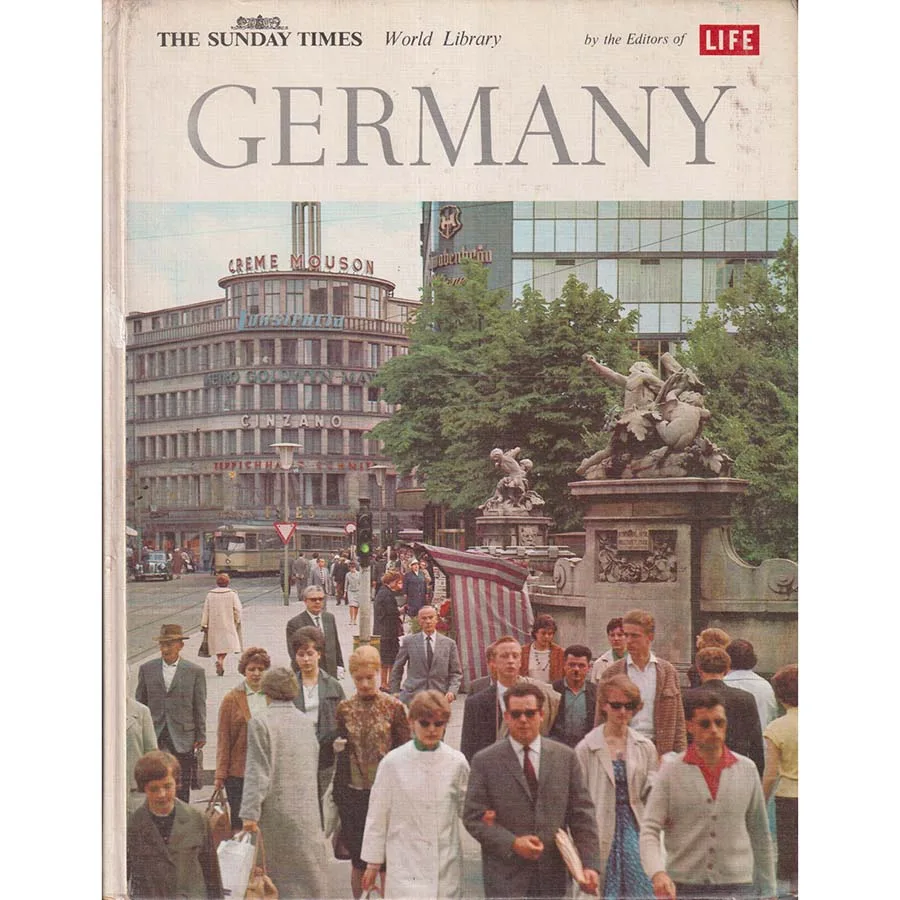
Publisher: The Sunday Times
Format: Hardback
ISBN: none
Germany - The Sunday Times World Library (1963) by Terence Prittie – The Sunday Times
ISBN: None
Condition: Good
Germany, 1963. Or, more accurately, two Germanys, because by this point the country had been divided so thoroughly by the Cold War that even Berlin had acquired a wall to make absolutely certain nobody misunderstood the situation.
Published by The Sunday Times as part of its World Library series, Terence Prittie’s Germany examines a nation still living directly in the shadow of the Second World War while simultaneously becoming one of the most important political and economic battlegrounds of the Cold War.
This was not history viewed from a comfortable distance.
In 1963, the war had ended only eighteen years earlier.
For many readers of the book, Germany was not somewhere associated primarily with Christmas markets, efficient trains and moderately alarming motorway speeds. It was a country they remembered from bombing raids, military service, rationing and newspaper maps covered in arrows.
Yet by the early 1960s West Germany had already undergone an extraordinary transformation.
Cities that had been devastated during the war had been rebuilt.
Factories were producing again.
Exports were booming.
Living standards were rising.
Volkswagens were multiplying.
And the Wirtschaftswunder, or “economic miracle”, had turned the Federal Republic into one of the major industrial powers of Western Europe.
Apparently, given enough engineers, factories and determination, an economic catastrophe can be repaired surprisingly quickly.
The buildings, admittedly, take rather longer.
East Germany presents a completely different picture.
The German Democratic Republic was part of the Soviet bloc, governed under a communist system and increasingly separated from the West not merely politically but physically.
The Berlin Wall had been built only two years before this book appeared, in 1961.
That alone makes the volume fascinating today.
Berlin was still one city in geography but two cities in political reality, divided by walls, checkpoints, armed guards and an ideological confrontation sufficiently serious that the world’s nuclear superpowers occasionally stood opposite one another wondering whether somebody might accidentally start the Third World War before lunch.
Checkpoint Charlie was not a tourist attraction.
It was a checkpoint.
East and West Berlin were not interesting historical curiosities.
They were competing political systems facing each other across concrete.
And nobody reading this book in 1963 could know that the Wall would eventually come down in 1989.
That is one of the great pleasures of old reference books.
They describe the present without knowing the ending.
There is no convenient paragraph saying:
“Do not worry excessively about this division. In twenty-six years people will be dancing on the Wall.”
Instead, the division looks permanent.
As indeed many people assumed it was.
Terence Prittie was particularly well placed to write about Germany. A British journalist with extensive experience of German affairs, he had reported on the country closely and understood the political, social and historical complexities far better than somebody arriving with a camera and a phrasebook for a fortnight.
That gives the book considerably more depth than the average illustrated travel volume.
Germany in 1963 was dealing simultaneously with reconstruction, prosperity, guilt, memory, political division and the uncomfortable question of how a new generation should relate to what had happened under National Socialism.
West Germany was democratic and increasingly prosperous, but many senior figures in public life had inevitably lived and worked through the Nazi period.
The country was therefore rebuilding not just cities but institutions, reputations and national identity.
There was no simple reset button.
Meanwhile, the younger generation was beginning to ask questions that would become much louder later in the decade.
What had their parents done?
What had they known?
Who had been responsible?
Why were some former Nazis still occupying respectable positions?
The answers were not always comfortable.
This makes a contemporary 1963 portrait especially valuable, because it catches Germany before many of those later debates had fully erupted into public life.
Then there is the physical Germany itself.
The Rhine.
The Ruhr.
Bavaria.
The Black Forest.
Hamburg.
Munich.
Frankfurt.
Cologne.
Industrial cities, medieval towns, agricultural regions and landscapes that had been fought over repeatedly by European powers apparently incapable of leaving central Europe alone for more than a few decades.
The Rhine naturally receives attention because no serious book about Germany can resist it.
It has castles.
Vineyards.
Industry.
Barges.
Legends.
Strategic importance.
And enough historical symbolism to sustain generations of poets, painters and generals.
The Ruhr, by contrast, represented the industrial engine room.
Coal.
Steel.
Factories.
Heavy engineering.
Smoke.
And enormous industrial complexes where people apparently went to work in clothing that remained inexplicably smart despite being surrounded by furnaces.
This was the era when heavy industry looked like the future rather than something destined eventually to become a heritage museum with an excellent café.
West Germany’s manufacturing strength was already becoming unmistakable.
Mercedes-Benz.
Volkswagen.
Siemens.
Bosch.
BASF.
Bayer.
German industrial names were re-establishing themselves internationally with remarkable speed.
If the country’s military ambitions had become understandably unpopular, its engineering ambitions remained vigorous.
The preferred method of dominating Europe was increasingly to sell it well-made machinery.
This proved rather more sustainable.
And then there are the cars.
Any ordinary street photograph from 1963 has now become a minor motoring exhibition.
Volkswagen Beetles appear in their natural habitat.
Mercedes saloons that were simply expensive cars at the time are now cherished classics.
Small Opels, Fords and assorted vehicles that nobody thought worth preserving are suddenly of intense interest to people prepared to spend three hours discussing the correct type of hubcap.
This is another accidental virtue of vintage books.
The photographer thinks he is photographing Cologne Cathedral.
The modern reader is examining the parked cars.
The cathedral is still there.
The cars are not.
Therefore the cars win.
The architecture is similarly fascinating.
Post-war reconstruction often meant replacing devastated historic districts with the clean lines, concrete and practical planning fashionable at the time.
Some buildings survived beautifully.
Others have since prompted generations of Germans to wonder whether perhaps the bombed ruin possessed certain aesthetic advantages.
But that too is part of the story.
The 1950s and 1960s were decades obsessed with modernity.
Old Europe had caused enough trouble.
Modern Europe would have motorways, apartment blocks, factories and central heating.
Surely nothing could go wrong.
The Sunday Times World Library approach suits the subject perfectly.
This was publishing from the era when editors believed the world could be understood by obtaining a sufficiently serious author, sending photographers abroad and placing the results between sturdy covers.
No video clips.
No clickable timelines.
No interactive map.
No notification asking whether you still wanted to continue reading.
You bought Germany.
You read about Germany.
It was an extraordinarily uncomplicated commercial arrangement.
And the physical book itself belongs to that pleasing period when reference works were expected to look authoritative on a shelf.
Put this beside volumes on Britain, Italy, Russia and Mexico and you begin to resemble somebody who receives confidential diplomatic cables.
Whether you actually understand international affairs is immaterial.
The shelf has already made its case.
For today’s reader, this volume now performs several jobs simultaneously.
It is a geographical portrait.
A piece of Cold War history.
A record of post-war reconstruction.
A study of divided Germany.
A collection of period photography.
And, unintentionally, a document from a world in which German reunification still seemed a remote possibility.
It is particularly interesting because almost everything politically important about Germany changed within the lifetime of people who first bought this book.
The Berlin Wall fell.
East Germany disappeared.
Germany reunified.
Berlin became the capital again.
The Soviet Union collapsed.
The European Community became the European Union.
And the country that had been physically divided in 1963 became one of the dominant economic powers of modern Europe.
Quite a lot for one old book to have missed.
Obviously, Germany is not a modern travel guide.
Do not rely on it for border crossings.
Do not expect East German currency to remain particularly useful.
Do not plan a journey around the Berlin Wall.
And if a motorway service station receives a glowing recommendation, there is a reasonable chance it has since been rebuilt approximately four times.
But as a snapshot of Germany at one of the most extraordinary moments in its modern history, it has become far more interesting than an ordinary contemporary guide could ever have hoped.
Condition: Good. A vintage copy showing the usual signs of age and previous ownership expected from a book published in 1963, but remaining in good overall condition and perfectly suitable for reading, collecting or leaving prominently displayed beside a model Volkswagen Beetle.
An excellent addition to a collection of German history, Cold War material, post-war Europe, vintage geography, Sunday Times World Library volumes or mid-century photography.
Also ideal for anyone interested in seeing Germany before reunification, before cheap European flights, before sat-nav, and before every British conversation about German roads inevitably included somebody saying, “Of course, on the Autobahn…”
Sold by Crappy Old Books, where Germany may have reunited, Europe may have transformed, and the Berlin Wall may have vanished, but thankfully nobody has yet found a practical reason to update a 1963 reference book.
Keep browsing: See more Travel books Other books by Terence Prittie
